| 1947:
|
First discovered by a pilot who almost crashed into the
cliff of the Maliau Basin escarpment.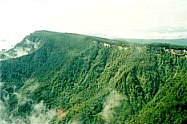
Geological Survey Department team reached Kuala Maliau
outside the Basin but did not enter.
Maliau Basin, as part of the Gunung Rara Class II
Commercial Forest Reserve, incorporated into Yayasan
Sabah Concession Area.
|
| 1960: |
| 1970: |
| 1976:
|
Forestry Department's
Botanical Survey team attempted to ascend the north
escarpment but failed to reach the rim. |
| 1980:
|
Sabah Museum team
ascended the north rim but were forced to turn back because
of illness and lack of supplies. |
| 1981:
|
Yayasan Sabah voluntarily
designated the area as a Conservation Area to be set
aside for research, education and training purposes.
First Yayasan Sabah survey parties dropped off by
helicopter on the north rim to demarcate the
Conservation Area boundary, cut a trail and construct
three helipads. |
| 1982:
|
The first reconnaissance
trip into the Basin by Yayasan Sabah, a preliminary
visit to plan the 1988 scientific expedition. |
| 1984:
|
Yayasan Sabah designation
of Maliau Basin Conservation Area approved by the Sabah
State Cabinet. |
| 1986:
|
Expedition team of four
entered the Basin from the south-west rim and trekked to
Kuala Maliau. The 'Jalan Babi' (Wild Pigs' Trail) first
discovered. |
1987:
|
BHP Minerals Company
undertook extensive geological survey work throughout
the Maliau Basin and surrounding areas to assess the
likely extent, depth and quality of coal seam resources.
|
| 1988:
|
First major scientific
expedition to Maliau Basin, jointly organised by Yayasan
Sabah and WWF-Malaysia. The report resulting from the
expedition outlined findings related to geology, soil,
hydrology, geomorphology, climate, plant studies, animal
studies and human impacts. From this expedition it was
brought to light that Maliau Basin is unique, with
several new species records for Sabah discovered in that
expedition alone. Besides its research output, this
expedition resulted in a widely screened documentary
film entitled "The Lost World of Sabah". |
| 1991: |
Sabah State Government
commissioned a Preliminary Environmental Impact
Assessment of the proposed coal development in Maliau
Basin. The study, undertaken by a Canadian consulting
company, included significant inventory work on plants
and vertebrates in the hitherto unstudied eastern side
of the basin. The finding disclosed that if mining is
to be taken even with stringent environmental
guidelines, related activities would still have serious
impact on the Basin, through increased access to
prospectors, hunters, gaharu and rotan collectors,
besides wider effects on the Ulu Kinabatangan generally.
|
| 1992
1993:
1994:
1996:
|
 Raleigh
International prepared the site of a research field
station building, and a helipad on the south plateau. Raleigh
International prepared the site of a research field
station building, and a helipad on the south plateau.
Camel Trophy Camp constructed with the
assistance of Camel Trophy participants.
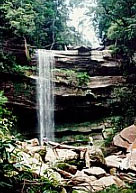
Raleigh International surveyed and explored the south
plateau.Takob-akob, Giluk and Mempersona Falls
discovered.
Second Maliau Basin Scientific Expedition, jointly
organised by Yayasan Sabah, University Malaysia Sabah
and Ministry of Tourism and Environmental Development,
Sabah, carrying out a more detailed study of the
south-western part of the Basin, making up approximately
10-20% of the total Basin area.
|
1997:
1997: |
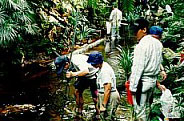 Gazetted
by the Sabah State Assembly as a Class I Protection
Forest Reserve and increased in size from 39,000 to
58,840 hectares to include the outer northern and
eastern escarpments and Lake Linumunsut. Gazetted
by the Sabah State Assembly as a Class I Protection
Forest Reserve and increased in size from 39,000 to
58,840 hectares to include the outer northern and
eastern escarpments and Lake Linumunsut.
Preliminary camp (Agathis Camp) set up near the southern
rim of the Basin.
|