With a total
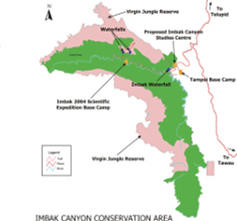
area of about 30,000 hectares, Imbak Canyon Conservation
Area encompasses two ridge-top Virgin Jungle Reserves plus
the Canyon itself and makes a significant contribution to
the coverage of protected areas in the centre of Sabah.
The Canyon
is a Class II Commercial Forest Reserve, part of the one
million hectare Yayasan Sabah Forest Management Area. In
2003, Yayasan Sabah voluntarily designated Imbak Canyon
as a Conservation Area for the purposes of research, education
and training, similar to Maliau Basin and Danum Valley Conservation
Areas. Only two expeditions have so far been carried out
in the area, one in 2000 organised by Sabah Forestry Department
and located at the mouth of the Canyon, and the second in
2004, organized by Yayasan Sabah and focusing on the centre
of the Canyon.
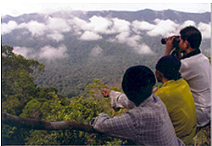
Spectacular view
of the Canyon from the heath forest
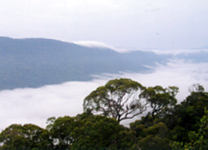
Early morning mist bathing Imbak Canyon
Why
is Imbak Canyon Conservation Area Important?
• It
is one of the last remaining substantial areas of unlogged
lowland dipterocarp forest in Sabah.
• It
is the origin of the Imbak River, one of the headwaters
of the Kinabatangan, Sabah’s most important waterway.
Conservation of a unique and rare area like the Imbak Canyon
upstream has significant co-relation to programmes such
as the World Wide Fund For Nature Malaysia’s 27,000
hectares “Gift to The Earth” Kinabatangan Wildlife
Sanctuary downstream, which was pledged by the State Government
in September 1999.
• It
plays an important role as a wildlife corridor connecting
Danum Valley Conservation Area and Maliau Basin Conservation
Area for major mammals like Bornean Pygmy Elephant, Sumatran
Rhino, Orang-utan, Tembadau, Bearded Pig and Clouded Leopard.
• It
plays a crucial role as a seed source or gene bank for facilitating
forest rehabilitation and restoration.
• Its
geographical position and its pristine state make it an
ideal site for research into the non-destructive use of
undisturbed forest, including carbon sequestration and bio-prospecting,
as well as of non-timber forest products and water catchment
management studies.
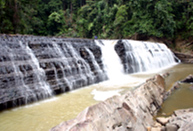
The 30m-wide
Imbak Falls
 Home
Home